Defining the Sinosphere

By Confused Laowai | Date: September 25th, 2011 | Category: Culture

I stumbled across this interesting wikipedia link the other day: The Sinosphere. It’s an article on a collective of countries (area?) that forms the sinosphere. Sino is a prefix used often to relate to China and its close knit Asian geography. Its etymology comes from the latin term: sinae, which is Latin for “The Chinese”.

Even some popular Mandarin/Chinese sites use this as a prefix: Sinoglot, Sinosplice. Chinese fans would often call themselves Sinophiles. However, what struck me as interesting in the Sinosphere wiki article is the Chinese name for it: 汉子文化圈. The Chinese Character Cultural Camp. It’s like a club!

The Sinosphere thus consists of countries that use 汉子 as first language ability. They also define it as “a grouping of countries and regions that are currently inhabited with a majority of Chinese population or were historically under heavy Chinese cultural influence.”

This includes, Vietnam, Korea, Japan, Taiwan and of course China. Look at this picture and see how Sinosphere is written within each country respectively.
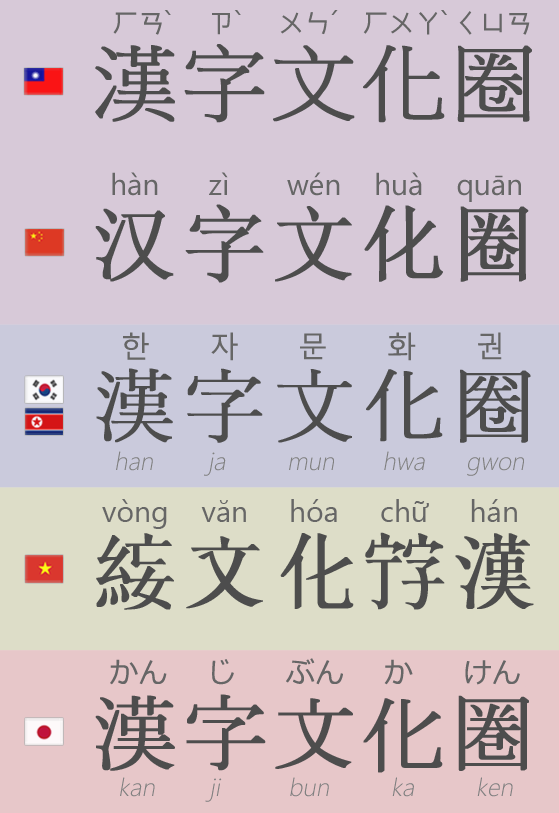
Sinosphere

Notice the various phonetic scripts (above the Chinese) used to pronounce the characters in their version of it. Taiwan: Zhuyin. Chinese: Hanyu Pinyin. Korea: Hangul. Japan: Hiragana and Vietnam: uốc ngữ (yeah I had to look that up!). But besides all these interesting things about the Sinosphere and it being defined by the use Chinese characters (via Chinese rule), the interesting part of it, is also the that some define the Sinosphere as countries that use chopsticks everyday!

Ain’t that nifty… now I wonder… doesn’t Singapore qualify for this? Mandarin is an official language there. Alas, the Sinosphere seems to harbour these three things: under Chinese rule or majority of Chinese population (or was historically), 1st language use of Chinese (emphasis on Hanzi) & chopsticks. Welcome to the Sinosphere.

Related posts:

LiWei Art
Cui Jian's Greenhouse Girl (花房姑娘)
Chinese Characters in the Wild
Radicals sorted by their first occurrence in HSK

Subscribe via email to receive new posts straight in your inbox!

Enter your email address:


  • Jack

    I think Singapore is not historically defined as “sinosphere” because it was originally Malaysian territory – They split with Malaysia only 40 something years ago .

  • http://niel.delarouviere.com NielDLR

    Hi Jack,

    I didn’t know that. That’s true. It’s probably why Singapore is not part of the Sinosphere. I wonder if it might be in the future?

  • http://www.facebook.com/manoush.zanj Manoush Zanj

    Hi Niel,

    I just want to point out that here the translation is 汉字文化圈,汉字 instead of 汉子. the latter would mean a brave guy…and i think by adding zi字 in the translation of Sinosphere linguistically limited the sphere in question. As it is a neology, there is still some ambiguity in its definition. if you read the French wikipedia page of this term, you could find that they concluded Singapore in the Sinosphere.

    Sinosphere is probably paralle to any other spheres in the world like Anglosphere, Francophone, Hispanosphere, etc. Wikipedia references are, however, not foolproofs. 汉字文化圈 could be used when talking about the linguistic relationship of Chinese language. 汉文化圈(a term i just invented if no one had ever used it before), for the cultural relation, a wider sphere including the linguistic one.

  • http://niel.delarouviere.com NielDLR

    Yes, I agree. These terms are notoriously loose. It was the first time I found the term I thought the definition, or they one Wikipedia gave is quite interesting. There is an interesting discussion on this post about Sinophone vs Sinosphere for instance:

    http://languagelog.ldc.upenn.edu/nll/?p=4306

    P.S. – Thanks for catching the error in 汉子 vs 汉字.