Oddities in Chinese: Hanyu Pinyin Syllables

By Confused Laowai | Date: October 5th, 2011 | Category: Language

I’ve been learning Chinese for almost four years now (a few more months to go). I still discover interesting things about Mandarin everyday. I remember back in 1st year of Chinese, we went through the Pinyin chart of syllables, getting the grips of Chinese pronunciation. Syllable after syllable we went: bo, po, mo, fo etc etc. Little did I know that now three years later I’m still finding some oddities in these syllable charts and Pinyin too.

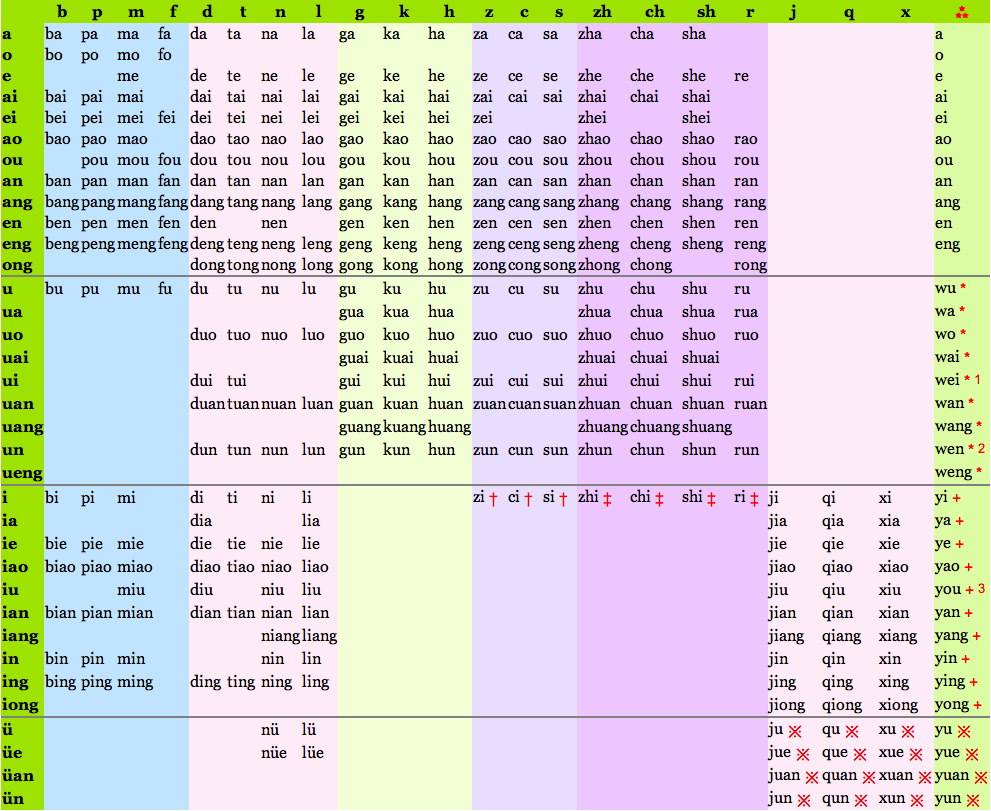
See below the Pinyin chart (source Pinyin.info)
Pinyin Syllables

Now here come the interesting parts:

1) Zero Initials starting with u, i and ü  are replaced with w, y and yu respectively

Zero initials are finals that act as the only form of the word, therefore an initial. Like en or ao for example. Look at the last column going down. You’ll see it in action from the second grouping onwards. U for example is replaced by W. So words like 我 (wo) can actually exist as uo. But some more interesting things are afoot.

2) Wei, wen & you are actually abbreviations.

Yeah, I did a complete double take on this. Now this is a bit confusing. Let me explain. Ui, un & iu are actually uei, uen & iou respectively. The IPA (International Pronunciation Alphabet) also shows this in its pronunciation, for example of ui is [u̯eɪ̯]. Now. Notice how pronouncing wei and and dui both end in the same sound. This is because they do: duei and uei. However, notice that uei is written as wei? See number 1. The W replaces the U.

Now why they changed duei into dui is a mystery. Same happens with dun and wen: duen and uen. If you are confused you are allowed to be.

3) ü is written as u when there is no ambiguity

No hold on. Why did I not know this before!? This one bowls me over. Look at the bottom rows. See there on the right, there are no ü! WTF. The reason why I had to look up the syllable table again, was due to the word 战略, pronounced as Zhànlüè, which means strategy. I didn’t know how to pronounce lüè as it was a bit tricky for me. Never seen it before. When I found the table, I realized it ends the same as 月. Hot damn.

Discussion

Actually the other day I wondered, why does the endings of wo and duo sound the same? Luckily I answered my question today. The same can be said for instance in the endings of you and niu. This comes from the second point, where they are actually the same sounds, but written differently (along with some weird abbreviations). Now, here’s the discussion. Why is Hanyu Pinyin written this way? Why are there these inconsistencies?

I’ve always thought that Pinyin is a bit strange. Somehow it’s just not there for me. I asked my brother to write down 不知道 in English. In Pinyin it is bù zhīdào. He wrote it as: boo tsjedao. Although this is an indication that Pinyin is not there on first use, it begs the question, is using a romanized script really such a good choice for presenting Mandarin sounds? I’m gonna ask some more friends to write down how they think Mandarin sounds in Chinese to test it. But I think the way you perceive a roman script is based on your language. For instance, a Spanish speaker who write it differently to an English speaker.

It comes back to Zhuyin, which uses it’s own script to present the sounds in Mandarin. This is a neutral way that is not influenced by a previous orthographic system. For instance, in point number 1, there are no ambiguities when it comes to Zhuyin. Look below – the first column is the zhuyin, the second column represents the pinyin equivalent:

It make more sense this way. At least to me.

What do you think? Can you read Pinyin easily? Are you bowled over like me too? Leave a comment below

Related posts:

Is Chinese a good choice for your first foreign language?
Feeling a bit stuck and lost
I have a drinking problem
  • bakhtinjali

    I am not the hugest fan of pinyin. Zhuyin seems to indicate syllables and pronunciation a little clearer for me. It’s interesting to note that once upon a time mainland China also used Zhuyin but later replaced it in the 1950s with pinyin, which was supposed to replace Chinese characters altogether. Even though early reformers used what look like English letters, they pulled their ideas from Russian, English and other languages to create the pinyin alphabet. If you are ever interested in digging a bit further, the PRC’s character reform committee ran a journal called “Pinjin” in the early 1950s that debated a number of different spelling systems for Mandarin.

  • http://niel.delarouviere.com NielDLR

    Oh, didn’t know they used Zhuyin for the Mainland a while too. Thanks for the comment. I’ll look into that journal. Will be interesting to see why they made the decisions they did.

  • http://twitter.com/YoshiCookie Steven C. Poling Jr.

    Pinyin requires some initial learning (perhaps 3-4 months), but after that time period it should be straight forward as it never changes (unlike English’s hodgepodge spelling system). But pinyin is just an introductory learning system, and should be disposed of as soon as possible by characters.

  • http://twitter.com/YoshiCookie Steven C. Poling Jr.

    注音 was invented in Mainland China in the early 20th Century. Many older Chinese (grandfathers and grandmothers) are still familiar with 注音 (and less so with 拼音).

  • Krys

    As a Chinese (and English) speaker myself, I must say that pinyin is the universal way of presenting the mandarin language. Since most of the people already understand how the latin characters work, it saves people a lot of time trying to learn the zhuyin, literally another set of characters like hiragana and katagana in Japanese.

    Learning the universal way of roman pronunciation is much easier than swallowing the zhuyin characters, don’t you think so? You have to learn it anyway, so why wouldn’t you take the shortcut… At least that’s what I feel, even as a Chinese. I know both zhuyin and pinyin, but zhuyin is just pain in the arse…

    If you compare the standard pinyin with what your brother wrote down, it is more simplistic and…easier to understand? To be honest, it will take me 5 minutes to under how to say “tsje” (and probably only English or Russian speakers can do that). Besides, once you understand roman pronunciation, you are set to learn another languages! It’s like the latin of language pronunciation and it is created for the convenience of the language learners. Well, at least to me, it is.

  • http://niel.delarouviere.com NielDLR

    Hi Krys,

    thanks for the comment. I’m going to have to differ with you.

    Orthography in its own way is a complex system. It is influenced a lot by your perception of your first language, but also by your own understanding of how these letters and words are strung together to make sounds. A good command of an orthography will allow you to spell better, however, this does not mean that when you have a command of it, that it is the best orthography out there. English sucks at orthography. The written word connection to sound is way off. Take this for example:

    The last ‘c’ in electric, electrician and electricity. Here the ‘c’ is in the same place in the word for all instances, but it is pronounced in three different ways. This is just an example of how some orthographies have really silly systems. Not even accounting for some people who don’t have a good command of their writing skills. One of my good friends reads A LOT, but he is not that good at spelling. It just sometimes happens. People have different skills.

    I feel this way about Pinyin sometimes. The example my brother gave (I’ll have to test it with more people) how far removed their orthography is from Pinyin. Unfortunately, yes, it’s a system and one that we have to learn, but the fact remains that there are some inconsistencies in it. Sometimes not
    making a lot of sense.

    Zhuyin, however, removes a little bit of this ambiguity, because it is sets
    it within a completely different framework, with no interference of previous
    orthographic knowledge. Although, your argument stands in terms already
    knowing a roman script, but then we might as well all learn IPA to write
    down the sounds of every language. Then there is literally no ambiguity.

  • ragnarok

    As a person who grew up with pinyin and knew practically nothing about zhuyin, in terms of usage I can’t be an impartial judge. But I have to say there is at least one advantage of pinyin during computer age – no need for a separate keyboard layout, isn’t it? ;)

  • http://niel.delarouviere.com NielDLR

    Oh yes. Completely forgot to think about that. Excellent point you have there!

  • Anonymous

    Hi Niel. I agree with you that a roman script is perceived / based on the languages and sounds we already speak and know. 

    I am not familiar with zhuyin so can’t comment on that.Regarding point 2, in my very humble opinion I do view ‘dui’ and ‘wei’ as two “slightly” different sounds. If you put together an Afrikaans ‘oe’ and an ‘ei’ sound or English ‘do’ and ‘ay’ sound and let them merge into one you have the sound for ‘dui’ with the lips starting in a slightly rounded position.The ‘ei’ sound in ‘wei’ is one that is more flat – not rounded and I guess sounds like English ‘way’. Probably a slight exaggeration of what really happens when you actually make these sounds so I guess my question is that the differences might be there – perhaps they are just subtle?

  • http://niel.delarouviere.com NielDLR

    Thanks for the comment Peckish Laowai.

    You actually raise a good point and is not something I thought about. However, they are different, because wei is actually “uei” and dui is actually “duei”. The difference lies in the initial, where “wei” doesn’t really have one. It’s a zero initial.

    However, the impact of the “d” initial in “duei” does impact the way the “uei” is pronounced, because of the normal phonological movement of the mouth. Thus to some extent I agree that it does sound a bit different than “uei”. However, phonetically, in Pinyin, “ui”, “uei” and “wei” are the same sound transcribed in IPA as [u̯eɪ̯].

  • Anonymous

    Interesting – learning something new every day. I actually didn’t know / realise that ‘wei’ doesn’t have an initial. I kind of though it was ‘wei’ sort of like ‘way’ in English :) I agree with you on this one for sure – wtf is a good expression for realisations of this sort – just when you think you actually knew something about Mandarin… :)

  • http://mykafkaesquelife.blogspot.com/ My Kafkaesque Life

    I think I should add your findings in my post “Pinyin sucks” http://mykafkeasquelife.blogspot.com/2011/03/taiwanese-hate-hanyu-pinyin-sucks.html where I try to collect these inconsistencies. Pinyin is far from universal, it’s completely random and hard to comprehend. If people would’ve not been afraid of ㄓㄨˋ ㄧㄣ ㄈㄨˊ ㄏㄠˋ, they would’ve quickly realized, that it represents the complicated phonology of standard Chinese much better.

    Hats down to your post and the discussion in the comments. You’re truly an independent thinker. Hanyu pinyin is a bad Romanization system and if there would’ve been a reform, I would probably be less critical about it. I also don’t get, why should for example “Hualian” be more intuitive than “Hualien”? Doesn’t make sense. 

  • Pingback: Oddities in Hanyu Pinyin | Mandarin Click by Click