The misty haze of Chinese dialects

By Confused Laowai | Date: July 18th, 2012 | Category: Language

Some linguists spend their lifetime on the topic of dialects and language classifications. Then we get the Chinese dialect continuum. Ooh boy. Time and time again I find it so hard to explain to people how Chinese dialects are viewed. You get “dialects” such as Min, Hakka, Wu etc, but then you also get dialects such as the Taiwan or Beijing dialect, which are actually variants of Mandarin itself, in accent, slang and vocabulary. What’s the difference?
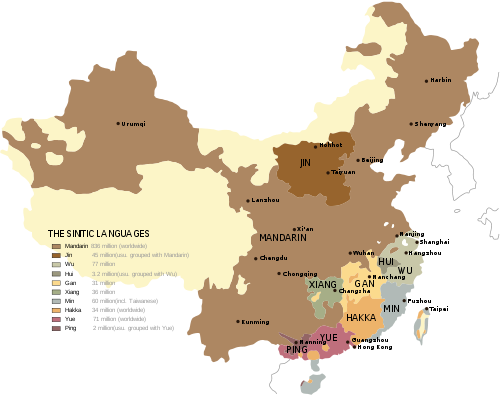
In my undergrad sociolinguistics module the topic of dialects was a heavily debated topic. In the end it came down to the fact what people define as languages or dialects are defined by the people, not linguistic differences. Mutual intelligibility is not always a method of determining if it’s a different language or not. Afrikaans (my mother tongue) is to some extent mutually intelligible with Dutch, from where it developed, but it’s not seen as a dialect.

You could then argue geographical proximity is the determiner of language vs dialect (Afrikaans is spoken in South Africa vs Dutch in Netherlands), but it’s not because you get the different dialects such as Mandarin vs Cantonese which are in close geographical proximity. I’m going on a tangent here, but I’d just like to mention that defining what is a dialect and what is a language isn’t that easy.

For instance, for political reasons, it would be better for China to portray the different dialects, Wu, Hakka, Min, etc as dialects rather than different languages to promote 和谐.

The main reason I’m doing this post, is an answer I recently read on Quora regarding the issue of Chinese dialects, specifically referring to the linguistic similarities:

The Min languages split off earlier, but most of the Chinese languages separated before or around AD 1000, which means that they have been evolving separately since then. The last common ancestor of the majority of the Chinese Languages was what we now call Middle Chinese, or Zhonggu Hanyu (中古漢語). Middle Chinese wasn’t a single language, but it was a mutually intelligible dialect continuum. Middle Chinese is about the same as late Vulgar Latin spoken in the western end of the Mediterranean just before the emergence of the languages we know today.

I quite like the distinction of Chinese dialects as the differences in Romance languages coming from a common ancestor.

Generally speaking, the non-Mandarin languages are somewhat more conservative phonetically and are clustered along the southeast coast. Cantonese preserves the Middle Chinese final consonants almost intact, while Gan mostly preserves them but has merged -p & -t, -m & -n. Mandarin has completely lost all Middle Chinese consonants except for -n & -ng, and some dialects have developed a new final consonant -r.

Nifty! Some linguistic nerdyness going on there, but it’s interesting to note at least.

In the end I like the distinction of Chinese dialects as varieties. Some might use the word different “language”, but it sometimes be wrong in saying that. I quote from Wikipedia:

The question of whether the various varieties of Chinese should be called dialects or languages in their own right is contentious. There are two principal uses of the word dialect. If varieties are considered dialects of a single language when they are mutually intelligible, and separate languages otherwise, then the principal branches of Chinese, and even some of the subbranches, are distinct languages. If, on the other hand, ‘dialect’ is used in its other meaning of a variety that is socially subordinate to a standardized or otherwise prestigious variety, perhaps one that shares a common written language and literature with the prestige form, then they are all dialects of a single Chinese language, though Cantonese and to a lesser extent Shanghainese and Taiwanese are local prestige forms with use in the media and a nascent literature.

In the end it’s hard to really say how you define it.

However, I feel when asked this question again about other Chinese dialects, the obvious question is always, what’s the difference between Cantonese and Mandarin, can you understand it?, then this will be my layman’s answer:

No, I can’t. They share some similarities though. Think of it as the difference in Romance languages, such as Spanish and French. They all came from a single ancestor. I would be able to read some signs and texts, but would not be able to speak or understand it when spoken.

Have you ever had to answer this question? What’s your answer?

Also, who have delved into other varieties of Chinese? Cantonese and Wu (Shanghainese) are some obvious choices. I’m curious! In the future, after mastering Mandarin of course, I might consider trying some other dialects.

Related posts:

Online Mandarin Dictionaries
Chinese signs and its linguistic landscape
Chinese-Ordered English
A visit from Beijing JiaoTong University and how 姜 trolled me

Subscribe via email to receive new posts straight in your inbox!

Enter your email address:


  • Pingback: Min and more « Learning SA Chinese

  • Robert Budzul

    I learnt Cantonese first and I find it much much easier than Mandarin. I suspect because Cantonese has more sounds I don’t have the problem with Mandarin that when spoken quickly it’s hard to pick out the words, i.e. everything sounds the same.

    Personally I think that the issue of dialect versus language is very much a political one. When speaking to Mandarin speakers from mainland China, there never seems to be any give and take – they just insist that Cantonese is a dialect and that is that. I suspect they’ve been brain-washed. Under normal circumstances I’d expect some different opinions but so far I’ve only heard the language option from Cantonese speakers.

    It doesn’t help that Cantonese speakers always write in standard Mandarin… this just convinces the Mandarin speakers that because they can read what Cantonese speakers write, Cantonese is a dialect.

  • http://niel.delarouviere.com NielDLR

    Hi Robert,

    I never really thought of Cantonese in that way. In the sense less homophony than Chinese. The first thing people say is “More tones! Way more difficult!”. Thanks for a new perspective.

    I agree. Language/dialectal divisions are notoriously political and social.

  • medicivalencia

    I don’t really know why we stick to call them Chinese dialects when they are really languages. The only thing they have in common is their ideograms system

  • http://niel.delarouviere.com NielDLR

    Languages & dialects are not defined by their linguistics traits, but by people. I quote from my post:

    “In the end it came down to the fact what people define as languages or dialects are defined by the people, not linguistic differences.”

    One person’s dialect, might be another person’s language.

  • medicivalencia

    I respect your point of view but I don’t really agree. I think that there is a science called Linguistics which is the only that can define what a language and dialect is. In the same way that gravitation is defined by Physics and so on.

  • http://niel.delarouviere.com NielDLR

    Hey Medicivalencia,

    I have a degree in linguistics. Languages do not work like that. It becomes extremely hard to define a dialect linguistically and how that differs from a language. How would you do that? Differing words? Differing geography? Differing culture? When does it suddenly become a dialect, rather than a language? Normally, mutual intelligibility is used as the “main” idea for the difference between language and dialect, but this is also problematic.

    I recommend you watch this video, which explains the linguistic perspective & problems more clearly than I would be able to write it:

    http://www.youtube.com/watch?v=ji6vURnWfrk

    and this one:

    http://www.youtube.com/watch?v=gbvCD29Sg58

    I give a personal example. My first language is actually Afrikaans, a language brought to South Africa by Dutch settlers in the 17th century. Due to isolation and change in the language, it became Afrikaans one of the official languages of South Africa. However, I can understand 75% of Dutch when its spoken and almost 90% when its written. Dutch people however have a lot harder time trying to understand Afrikaans. Besides the problems with mutual intelligibility, a lot of people would say its close enough to consider Afrikaans to be a dialect of Dutch, but it’s not. There’s more to language than just its linguistic properties. Afrikaans has its own culture and is geographically isolated.

    Now, if we put Afrikaans and its community in the Netherlands, this classification would definitely be different. That just shows how hard it is to define a language versus a dialect. There are many more examples: Urdu vs Hindi, Swedish vs Norwegian, Chinese and its dialects, Spanish & Portuguese, heck even many of the Romance languages can be considered dialects of Latin, but that’s not how we define it.

    As I said, most of the time, the difference between language and dialect is determined by sociolinguistic factors.

    I hope you understand this a bit better? If you have any more questions, I’d definitely answer them

  • medicivalencia

    I strongly believe that mutual intelligibility is the key of the difference between a language and a dialect. A language is mainly a common code that a group of people use to make them understand. Anyway the main problem is when you try to mix politics with linguistics. People from Sweeden and from Norway can understand each other. For me, Sweedish and Norwegian are the same language but they prefer to keep different names for political and national reasons. In any case, Sweedish and Norwegian are two branches from the same language. It’s what is actually called “glotonyms” (two labels to refer to the same language).

    I also can give you my example. My mother tongue is Catalan, but I speak a dialect called Valencian. Many people defends Valencian is a different language from Catalan just because they don’t want to feel identified with the Catalan folk, but reality is we use 98% of the same words and we can understand mutually without any kind of problems. Politicians in Valencia encouraged this controversy to try to get more votes or to make increase hate towards Catalans. Finally, the official agreement is that Catalans and Valencians speak the same language but in Valencia the name of Valencian for our language we’ll be respected. Something similar to Dutch in Holland and Flammish in Belgium.

  • medicivalencia

    And excuse my bad English! XD